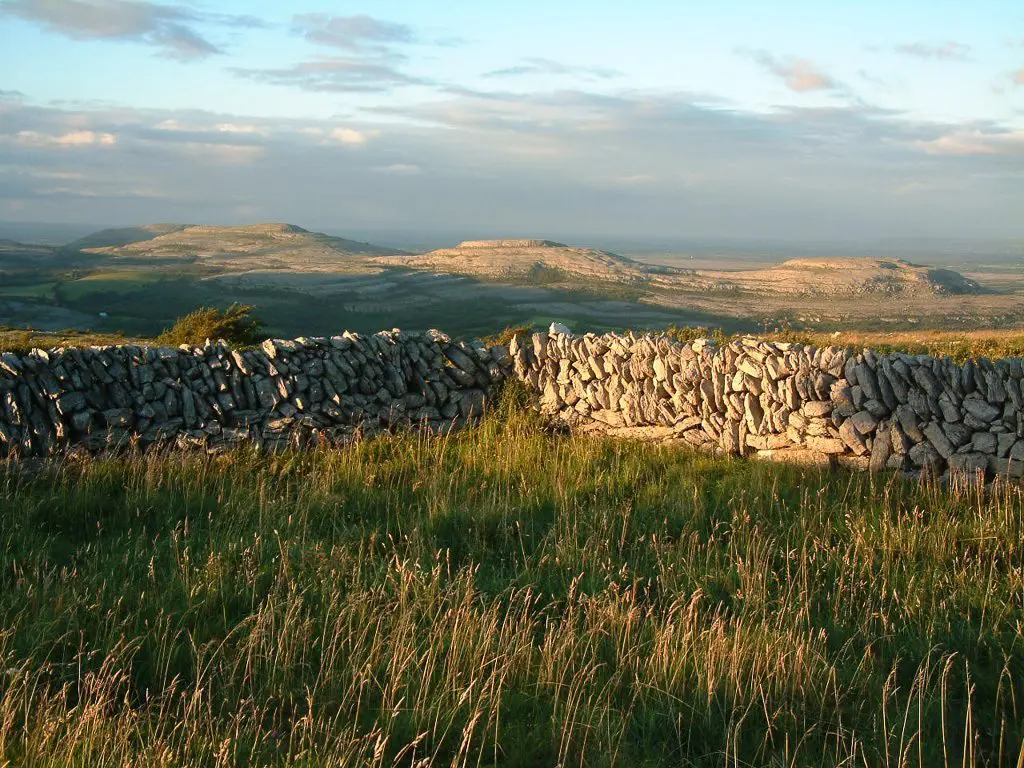
Burren History Pre Famine
The plantations of the 17th century resulted in much the lands of the Burren being redistributed. The Book of Survey and Distribution (Simmington, 1641) recorded 35 different land types in the barony of the Burren, broken down into 121 sub-types based on their profitability. Fourteen different types of pasture, of 69 different profit levels, were distinguished, such as Dwarfwood pasture (? profit, ½ profit etc), Rockie pasture (¼ profit, ? profit etc.), and Rockie shrubby pasture (? profit etc.).
This diversity, which is a hallmark of the Burren and a key factor in the cultural and ecological wealth of the region, must be recognised and accommodated in management schemes today if these schemes are to prove successful in delivering upon their stated objectives.
Following the plantations, sheep farming would appear to have attained prominence in the uplands, with vast flocks being kept by the main landowners, often on a year-round basis. The fascinating Statistical Survey of Clare (Dutton, 1808) records in the Burren that ‘immense numbers [of sheep] are annually reared, and usually sold at the fair of Ballinasloe in October … a small part feeds store bullocks’.
Dutton also notes that ‘the limestone crags of Burrin ... are, with some exceptions, devoted to the rearing of young cattle and sheep, and some so very rocky that four acres could not feed a sheep’. At this time for the smaller, local farmer however, mainly based in the coastal and valley areas of the Burren, a mixed economy based around the cow, pig, goat and the potato, on a dwindling land base, was prevalent.
Considering the contemporary perspective of the Burren as an ecological, cultural and geological haven, it is interesting to note that, historically, it was the agricultural quality of the Burren that took precedence, and seemed to generate most interest among observers.
Ludlow (1651) refers to the ‘sweet and nourishing’ grass patches in the uplands; Dineley (1681) notes that the Burren ‘raises earlier beef and mutton … than any land in this kingdom, and much sweeter by reason of the sweet herbs intermixed and distributed elsewhere’; Lord Willies (1761) describes the sweet grass and shelter afforded to sheep by the uplands, so good that ‘it fattens them prodigiously’ producing ‘near double the tallow of a sheep the same size fed upon rich pasture’.
Roy (1788) claims that the hills provide ‘the finest pasturage’ for sheep; Coulter (1852) states that ‘the fat sheep and cattle of the Burren’ were ‘proverbial amongst Irish agriculturalists’ [all cited Ó Dálaigh, 1998]. Even the geologist F.J. Foot (1863) expounded the virtues of the Burren soil ‘than which none is more productive’, providing pasture that is ‘so rich and fattening’.
- The Trust
- The Burren
- Visitor Info
- News & Events
- Learning Landscape
- Curious Kids
- PBL– building a network?
- Landscape Learners
- Heritage Helpers
- Burren Shop

