

The Burren Pine Project
Restoring a ‘lost’ species to Ireland’s natural flora

The remarkable re-discovery of Ireland's native pine after 1,500 years
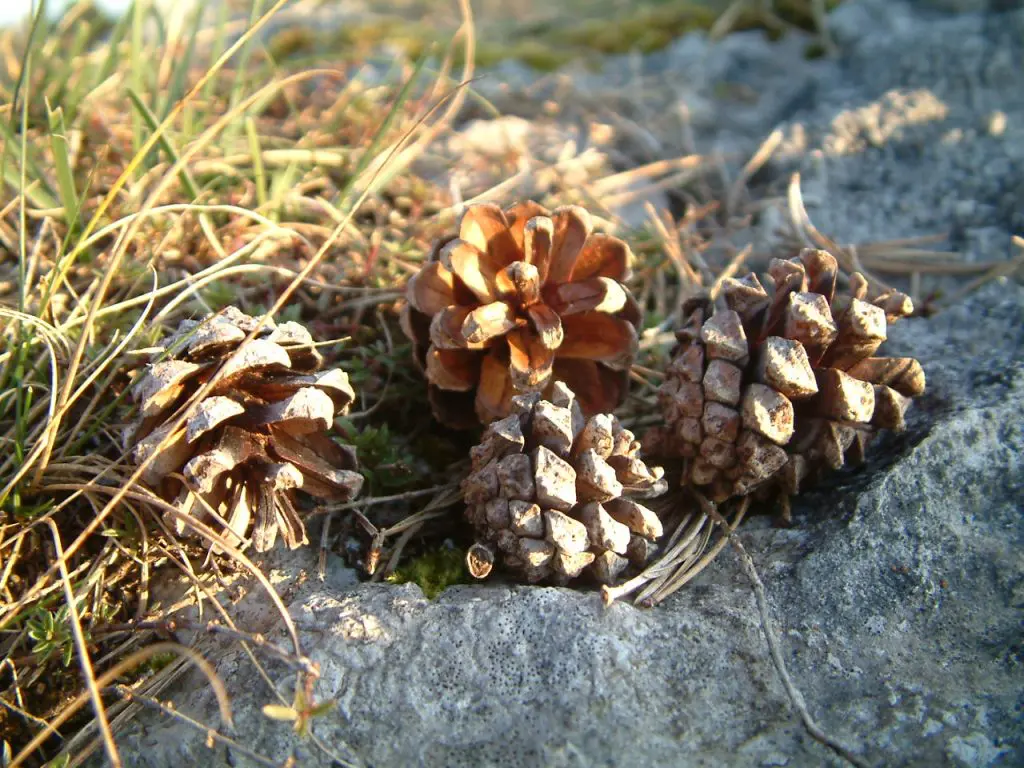
The beautiful Pinus sylvestris is Ireland’s only native pine tree which, according to pollen and archaeological records, once dominated the Burren landscape. Thought to have died out in Ireland around 1,500 years ago, it was later reintroduced from Scotland, leading to its common name ‘Scot’s pine’. Thrillingly however, recent investigations by scientists at Trinity College Dublin confirmed the presence of a ‘microrefugium’ of native pine trees at a remote site in the Burren, Co. Clare. This remarkable find was verified by pollen analyses and the details published in a peer reviewed paper.
Further information
The latest research has confirmed that the Burren supports the only confirmed native stand of pine trees and that this ”native population of pine trees is of high conservation value but its rarity increases its extinction risk. Cooperation between forestry and nature conservation agencies is needed to ensure its continued survival and to develop opportunities for the restoration of native pinewoods in Ireland.”
Archaeological evidence
Two shell middens/habitation sites at Fanore More were excavated between 2009 and 2014 by Michael Lynch with the assistance of the Burrenbeo Conservation Volunteers. Radiocarbon dates from the sites show them to be Later Mesolithic ranging from approximately 6,000 to 7,000 years ago. The charcoal analysis was carried out by archaeobotanist Mary Dillon. This showed that over 80% of the charcoal from Site 1 and over 95% from Site 2 was Scots Pine (Pinus Sylvesteris). The analysis also showed that most of the charcoal came from large branches or tree trunks rather than small branches and twigs. Pollen analysis has shown that Scots Pine would have been a dominant tree species in the area at that time. This high percentage of Scots Pine use as firewood on an archaeological site in Ireland is most unusual. It reveals a special relationship between the Mesolithic hunter-gatherers of north-west Clare and this iconic tree.
The charcoal from sites one and two have been analysed. The most remarkable and significant results from both sites is the complete dominance of Scots pine as the choice of wood for fuel: it accounted for 85% of the charcoal from site 1 along with small amounts of yew, hazel and oak, while this proportion increased to 95.9% at site 2, with birch and willow or poplar making up the remainder. It is difficult to explain this phenomenon which is unique in Irish archaeology and any attempt at interpretation will have to wait until completion of the remaining analyses, such of those as the burnt stone and shells.
- Lynch. M. 2017 The Later Mesolithic on the north-west Coast of Clare. Archaeology Ireland 31 (4) No.122.24/28.
- Dillon. M. 2016 Charcoal Analysis from Fanore More 2 unpublished report.
Links to further resources
- Molecular characterisation of Pinus sylvestris (L.) in Ireland at the western limit of the species distribution – Samuel Belton1†, Philippe Cubry1,2†, Jenni R. Roche3 and Colin T. Kelleher1*
- Michael Viney: The mystery of the Irish ‘Scots’ pine, The Irish Times, Feb 4th 2017
- Recent findings on the native status and vegetation ecology of Scots pine in Ireland and their implications
for forestry policy and management – Jenni R. Roche - Re-defining the natural range of Scots Pine (Pinus sylvestris L.): a newly discovered microrefugium in western Ireland (Alwyne H. McGeever and Fraser J. G. Mitchell) Journal of Biogeography (J. Biogeogr.) (2016).
- Palaeoecological Evidence for Survival of Scots Pine through the Late Holocene in Western Ireland: Implications for Ecological Management (Jenni Roche, Fraser Mitchell, Steve Waldren, Bettina Stefanini). Forests, 10.3390/f9060350, 9, 6, (350), (2018).
- Plant community ecology of Pinus sylvestris, an extirpated species reintroduced to Ireland (Jenni R. Roche, Fraser J. G. Mitchell & Steve Waldren, 2009). Biodiversity and Conservation volume 18, Article number: 2185 (2009)